
Writing is a funny thing. Any writer will tell you this. For a couple of weeks, I’ve had it in my mind to formulate a response to Seth Dunn, the polite Calvinist who has not responded to my query What Exactly Are We Doing Wrong? A Liturgical Challenge to Calvinists, yet did not find motivation to sit down and get to it.
Today? Pfffffffftttt………….I can hardly stop writing. I’ve been at it most of the day, grinding out two blog pieces on Orthodox praxis and the Bible, pieces with which I am sure that most dedicated Calvinists will take issue. Nonetheless, here comes the third – on the Eucharist.
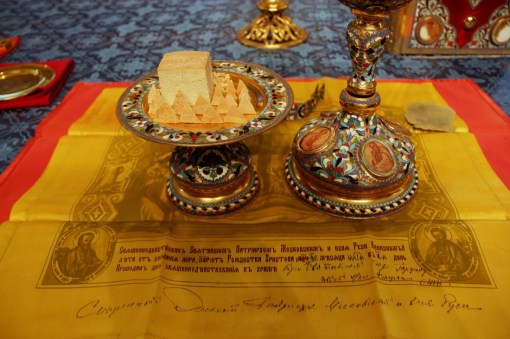
As mentioned in my first piece, the Divine Liturgy is divided into two distinct parts – the Liturgy of the Word before the sermon, and the Liturgy of the Eucharist. The titles here show us the emphasis in each phase of the worship. Everything after the sermon directs our attention to our soon participation in the Body and Blood of Christ. While the Liturgy of the Word is a kind of lead up to the Eucharist, the Liturgy of the Eucharist gets down to the true meaning of the Liturgy – that of receiving Christ and uniting to Him.
After the sermon, a third series of prayers are offered, the THE LITANY OF FERVENT SUPPLICATION. Once again we offer prayers and supplications for others, which command is found in Scripture.
The next thing to be done is the GREAT ENTRANCE with the singing of the CHERUBIC HYMN. Done slowly and with reverence, it is one of the most beautiful hymns in the Liturgy. There are many different melodies, according to the ethnicity of a particular parish, but the message is the same – set aside your earthly cares, for Christ comes to be with us.
There follow from here more prayers, the recitation of the Nicene Creed, additional prayers, and then the singing of the Anaphora Hymn, which again, finds wording in the Scriptures:
“Holy, holy, holy, Revelation 4:8 Lord of Sabaoth, Luk 6:5 heaven and earth are filled with Your glory. Hosanna in the highest. Mar 11:10 Blessed is He Who comes in the name of the Lord. Mat 21:9 Hosanna in the highest.”
This is Bible. This is Scripture. This is praise to the Lord of all.
Even in the Calvinist church I went to, the next words the priest speaks were familiar to me, and to everyone who has received Holy Communion in a Christian church:
“Take, eat, this is My Body, which is broken for you for the remission of sins.” 1Corinthians 11:24
“Drink of this, all of you; this is My Blood of the new covenant, which is shed for you and for many for the remission of sins.” 1Corinthians 11:25
The difference – which the Calvinists reject – is that we mean it, just as Jesus did. The elements truly become the very Body and Blood of Christ when consecrated by the priest. By this great mystery, we receive into our very being that which the Early Fathers of the Church called, “The Medicine of Immortality,” for we do not understand salvation in the legal terms of lawbreaking as do the Western churches, but rather in terms of healing our souls of the sickness of sin. This also is scriptural, for Jesus said that He had come as the Divine Physician to heal those who are sick. Matthew 9:12
Jesus said, “This IS my Body.” Matthew 26:26. No amount of fancy hermeneutical gymnastics can make this verse say, “This represents my Body.” How then do you charge the Orthodox with violations of the Bible when we believe exactly what that verse says? How do you claim to be “Bible-believing” or “sola scriptura” when you deny what is clearly written? How do you charge the Church with error when Christ promised that the Church would be protected from error. St. Paul stated that the Church, and not Mssrs. Luther and Calvin, is the “pillar and ground of truth.” 1Ti 3:15. While I understand that the Reformers were appalled at the corruptions of the Roman Church, you do not throw out the baby with the bathwater by changing that which has been taught from the very beginning and then coming up with unique hermeneutical grotesqueries to explain away the clear meaning of John 6: 51-56. In doing this, the Reformers inferred that the Early Fathers were uneducated dunces who did not know how to properly interpret Scripture.
The Our Father Luk 11:2 is recited by the faithful. But before that, something truly terrible happens. Another hymn of praise is sung to the Theotokos:
“It is truly meet to bless you, O Theotokos, ever-blessed and most pure, and the Mother of our God. More honorable than the Cherubim, and more glorious beyond compare than the Seraphim, without defilement you gave birth to God the Word. True Theotokos we magnify you!”
As I said in my last installment, I understand how Calvinists feel about this, having been in that camp for twelve years myself. Yet listen to how an Orthodox website describes the meeting between the Virgin Mary and the angel Gabriel.
The Archangel Gabriel was sent by God to Nazareth in Galilee. There he spoke to the undefiled Virgin who was betrothed to Saint Joseph: “Hail, thou who art highly favoured, the Lord is with thee: blessed art thou among women. And, behold, thou shalt conceive in thy womb, and bring forth a son, and shalt call his name Jesus. He shall be great, and shall be called the Son of the Most High: and the Lord God shall give unto him the throne of his father David: And he shall reign over the house of Jacob forever; and of his kingdom there shall be no end.
Highly favored. Blessed among women, that is, more blessed than any other woman ever to live. Yet Protestants seem scared to death to give even the slightest honor to one who was so honored by God. And the distortions (*sigh – okay, let’s call them what they are – lies) they tell about Catholics and Orthodox worshiping Mary are ridiculous. No matter how many times in a debate we tell people that we don’t worship Mary, that only God is worthy of worship, etc etc etc, we still get accused of idolatry and worshiping Mary. All I can say is, WE DON’T!! I’m sorry you don’t have the decency to believe us, that you feel you must put words in our mouths and ascribe to us motives which do not belong to us. I would hope better of you, especially if you really wish to learn. It seems though that many (not all, but many) Protestants would rather make smarmy comments and lie about us rather than take at face value the statements we make.
After the reception of the Eucharist, there are closing prayers and a blessing. And that’s pretty much it. For lack of space, I haven’t gone into great detail here, but have tried to show that there is a great deal of Bible in the Divine Liturgy of St. John Chrysostom.
So, Calvinists, what exactly is your objection here? I see a few things that J.D. Hall spoke of in his aforementioned accusatory blog piece. What Mr. Hall did was not apologetics, that is, he did not give specific reasons that he opposes clerical garb, icons, prayers to the saints,candles, and all the other assorted “pageantry.” He does not describe at all what about the Orthodox faith is “pagan” or “superstitious.” All he did was to insult. In a formal debate, such actions would lose him points, as well as the respect of the judges and his opponents. Sir, you must prove with FACTS that Orthodox is “anti-Christian.” In light of your inability to do so, you have simply devolved your argument to slander of the worst sort.
In the next installment, I will get down to some of the more specific things which Mr. Hall finds distasteful (as if his personal tastes dictate proper worship) and see if I can formulate a reasonable answer to him for why we do what we do. Stay tuned. In my following posts I will discuss architecture and Proper Worship.
 Muddling Through Life
[…] Part Three – The Eucharist […]
LikeLike
I really like the Cherubic hymn! “Let all mortal flesh be still, and in fear and trembling stand, pondering nothing earthly-minded, for the King of Kings and the Lord of Lords come to be slain, to give Himself as food to the faithful. Before Him go all the principalities and power, the many eyed-cherubim and the six-winged seraphim, crying, ‘Alleluia! Alleluia! Alleluia!'” I think those words describe or illustrate, as perfectly as words can describe or illustrate such a thing, the proper attitude of reverence and silence before the Cross and the Gift of Christ!
LikeLiked by 1 person