

What is proper worship? Is it an intellectual exercise as set forth in the Regulative Principles of Calvinist worship? Or has it always been meant to be something deeper and more life-changing than bringing the minds of the listeners to assent to a bunch of facts? Do the Orthodox worship properly and how do we know that they do from the Bible? The charge J.D. Hall and the fellows of Pulpit and Pen have set out in their nasty and disingenuous (not to mention ahistorical) screed against the Orthodox Church is that the Orthodox do not. Worse than that, Mr. Hall apparently has a penchant for tendering gratuitous and lying insults and trying to pass them off as quality apologia.
Apologetics is the science of defending with FACTS which support your beliefs, not engaging in round after round of slander so you can leave the verbal battlefield thinking you have won the day by the use of charming little pejoratives. I was told by a friendly online Calvinist that Mr. Hall is a “formidable foe.” He is anything but. He is an ill-mannered insult artist, which hardly qualifies him as an apologist. I hope that the last three blogs I have written, beginning with A Response to Pulpit & Pen, have shown this to be so. I also hope I have done apologia and shown that there are reasons, both from Christian history and the Bible, that we Orthodox worship in the manner that we do.
The purpose of worship is set out in the book of Hebrews:
Heb 8:4 For if he were on earth, he should not be a priest, seeing that there are priests that offer gifts according to the law: 5 Who serve unto the example and shadow of heavenly things, as Moses was admonished of God when he was about to make the tabernacle: for, See, saith he, that thou make all things according to the pattern shewed to thee in the mount.
The word “admonish” is a word of certain severity in which God is strictly warning Moses not to tamper with any of the patterns of worship that God had shown him. This is because, as the verse states, the worship which would take place would be an “example and shadow” of the true worship in heaven. Hebrews 9 draws this out a little more:
Heb 9:23 It was therefore necessary that the patterns of things in the heavens should be purified with these; but the heavenly things themselves with better sacrifices than these. 24 For Christ is not entered into the holy places made with hands, which are the figures of the true; but into heaven itself, now to appear in the presence of God for us:
Figures of the true. Patterns of things in heaven. I remember hearing a Protestant pastor once teach on this and state that because of the strategic location of the Jews and their tabernacle, all the pagan tribes around them could observe what was happening. It was a witness to these pagans to the true and living God, an invitation for them to enter Israel and join in that true worship. It was, according to Hebrews, a shadow of heaven.
If this is true of the Old Covenant worship, which pointed to Christ, how much more important is this in the New Covenant when our worship should speak of all that Christ has done and the realities of heaven which exist in the reality of the Resurrection? This is why we have icons of the saints in our churches – because they are alive because of the death, burial, and glorious Resurrection of our Lord. Take away our Lord’s passion and victory over death on the Cross and they are still dead and in their graves. But the fact that the Resurrection has imparted to them life in Christ means that we can acknowledge them as alive, able to hear our prayers. We place their icons in the midst of us, not to be worshiped as God is worshiped (how many times am I going to have to say this?) but as reminders of their lives and their continuing presence among us. And this is biblical:
Heb 12:1 Wherefore seeing we also are compassed about with so great a cloud of witnesses, let us lay aside every weight, and the sin which doth so easily beset us, and let us run with patience the race that is set before us,
The saints see, they hear, they are more alive than we can, in our puny imaginations, comprehend. Christ spoke with them Mar 9:4, proving that the dead are very much alive in Him. Icons remind us that we are a family in Christ. They celebrate the deeds of God’s people. We are family, with a common Father in heaven.
J.D. Hall apparently doesn’t even understand what an idol is as he accuses the Orthodox Church of “idolatry.” An idol is any created thing which is worshiped as God and in the place of God. It is a false god. The sad part is that one could probably tell Mr. Hall a thousand times that we do not consider icons to be God, nor do we worship them as God, and he wouldn’t care. He has made up his mind that icons are idols and that settles it for him. He would have been a very happy camper in the Byzantine Empire of Constantine V running around with an axe in hand destroying churches and burning icons.
The Seventh Ecumenical Council condemned iconoclasm on one biblical principle: God made an icon of Himself and set that icon in our midst – our Lord Jesus Christ. Scripture says of Jesus:
Col 1:15. Who is the image of the invisible God, the firstborn of every creature.
The word image in that verse is – guess what: εἰκών (icon)
But I digress. Let us turn now to the architecture of a properly done Orthodox church. One of the first things that spoke to me as I entered the church where in 2001 I entered the Church from Protestantism was how the worship area is divided into three distinct sections. This separation is historical and goes back far beyond the Reformation.
Upon entering an Orthodox church, the first thing you will notice directly in front of you will be an ornate wall of some kind, liberally decorated with icons. This is the iconostasis, or Icon Screen. It separates the Altar and Holy Table from the area where the faithful stand to worship (There is no sitting or kneeling in a proper Orthodox parish because there are no pews). This Icon Screen is one of many symbolic architectural pieces which Mr. Hall lambastes as “pretentious pageantry.” His comment makes it obvious he has not “eyes with which to see.”
The biblical basis of the Icon Screen is the Temple in Jerusalem. Look at the similarities:
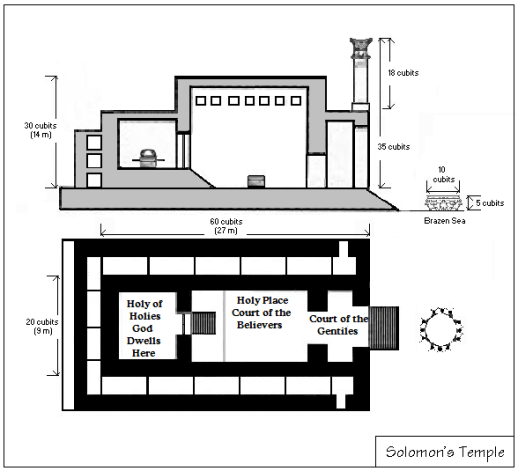 The Holy of Holies was the place where God dwelt. So holy was it that only the high priest could enter, and that only once a year. To intrude was to be struck dead. The faithful are separate from God in the Court of Believers. It is symbolic of God being separate and different from us – the transcendence of God.
The Court of the Gentiles was the place where those who were not Jewish could observe the worship of the faithful. It was God who gave the instructions for Solomon’s Temple, and as noted before with His warning directive to Moses – it was not to be altered by human feelings or tampered with by thoughts of what might be better. Now look at the corollary in the Orthodox Church:
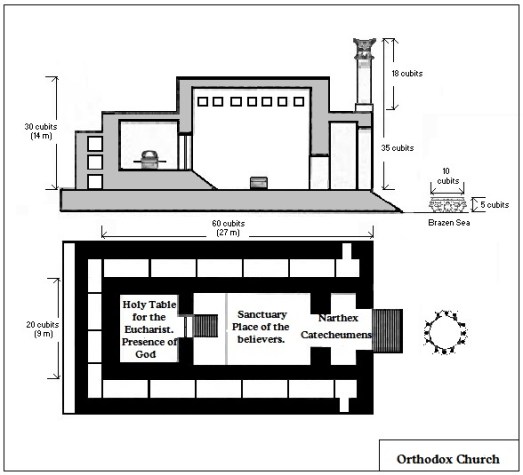
Again we see a special area where God is present-the Holy Table with the Tabernacle of the Eucharist. This again symbolizes God is separate from us, and shall always be. The Sanctuary is the Court of the Believers, and the Narthex is the Court of the Gentiles. In the New Covenant, the “Gentiles” are those who are either not of the Orthodox faith or catechumens. In days past, after the sermon, the catechumens were prayed for and then it was announced for them to depart. They would not see the Liturgy of the Eucharist until they received the Eucharist when they were baptized into the Church. This prayer is repeated in Orthodox parishes today, but the catechumens are allowed to stay.
Symbolism is very important in Orthodox worship. It was given to people who, for centuries could not read, but who could understand symbols and pictures which depicted truth. For instance, we stand for the entire Liturgy because we have been redeemed and forgiven. Kneeling is a posture begging forgiveness for a crime. We are forgiven, and as obedient children we stand, attentively listening and awaiting instruction from our loving Father. This is why there are no pews in correctly constructed Orthodox parishes. Pews also have the symbolism of sitting to be entertained. That is not what we are there for. We stand, receive our instructions from the Gospel, experience Christ in the Eucharist, and leave to go out into the world to be witnesses.
Where is the symbolism of God’s transcendence in any Protestant church? It is not there, and if anything, (this is my opinion) the symbolism is that rather than experiencing the mystery of God in the Eucharist, Calvinism prides itself on striving to be equal to God by understanding Him thoroughly. It is an exercise of intellect, bolstered by long sermons attempting to unveil the mystery of God and make Him less transcendent and mysterious.
This is also, as Hebrews 8:5 and 9: 23-24 state, a pattern of the heavenlies, for even in heaven, even as the redeemed of God, we shall never be His equal. He shall always be transcendent to His Creation and His creatures.
So tell me, Calvinist, what problem do you have with this now that you understand it a bit better? Is this “pretentious pageantry,” or is it important symbolism which properly represents heavenly realities and speaks to the heart? Who is following the patterns of the Bible now and who is not?
 Muddling Through Life
[…] In the next installment, I will get down to some of the more specific things which Mr. Hall finds distasteful (as if his personal tastes dictate proper worship) and see if I can formulate a reasonable answer to him for why we do what we do. Stay tuned. In my following posts I will discuss architecture and Proper Worship. […]
LikeLike