
In the middle of the violent protests and racial unrest in this country, I want to publish something that I hope will in some way defuse the idea that pride in the South, including the flying of the Southern Battle Flag, is based strictly in a desire to return to the days of Jim Crow, segregation, and the desire to persecute and suppress black people. This writing is from the first chapter of my book, MAGNOLIAS IN DECEMBER. I wrote this book for my grandchildren so they could know a little bit about me and what life in the South was like in the 1950’s. This is chapter one of the book.
DIXIELAND
There is a saying I heard once upon a long time ago and have remembered as true for the rest of my life. I have shared this saying in discussions with a few people from the South whom I met up here in Yankee land. To a man (and woman) when they hear this old nostrum, they will smile and nod their heads in agreement. It is a fine old saying, and very true:
“You can take the boy out of the South, but you cannot take the South out of the boy.”
To be born in the South is something special. It puts one in touch with an experience that is to be had nowhere else in the world. It is a way of living particular to that area and which goes with a man all his life, no matter where he finds himself. If he is from Georgia and he meets another young fella from Buckhead or Marietta, from Chamblee or Valdosta, they are immediately brothers in a shared life which is not understood by city-dwelling Yankees from the North. They share in the experience of shinnying to the top of seventy foot Loblolly pine tree, and there to hold on dear life while observing all happening below. They know the delightful, musty smell of pine straw on the floor of a forest so thick with pines that you cannot see the horizon. They have probably been taken on a Snipe hunt by their fathers, lying in the woods holding open the mouth of a burlap bag and waiting for their dads to chase the elusive snipe into it. They have chased cows and chickens through immense green fields of grass. They know swimming in a cool creek on a day so hot it would make the devil would sigh. The sweet taste of muscadine, that particularly Southern grapevine species which has been extensively cultivated in this region. We have all manner of things, people, and places that the North does not have, and of which you cannot make a Yankee understand.
For some reason unbeknownst to me, I woke up a while back humming the familiar strains of “Dixie.”
“Ohhhhhh, I wish I was in the land of cotton,
Old times there are not forgotten.
Look away, look away, look away,
Dixieland!”
I am inclined to attribute this to my recent occupation with things of the South in the last several weeks, including a wonderfully nostalgic website upon which are posted numerous old pictures and post cards of the area in and around my childhood hometown of Atlanta. They are dated from the beginning to the end of the twentieth century, with what appears to be special emphasis on in the middle part of that era – the time I was a youngster. Long evenings have been spent clicking on link after link, looking at pictures of buildings long since destroyed by the wrecking ball, and remembering certain events associated with those buildings. It is a real stroll down memory lane for me. I am in the grip of a severe nostalgia for a more innocent time in my life. I look upon these photographs and hear the ghosts of a time that will ever rest gently in my mind.
All these things, and a thousand more, are the experience of growing up in the South, and not only would the boy not trade those memories for all the gold in the world, but the song “Dixie” reminds him of a time and place when life was innocent and pure for him as a child.
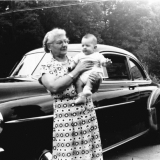 The magnificent 1951 Chevy Belair & your great-great-grandmother, Rose Impellitteri, in the driveway of our first house at 1171 Church Street in Decatur. Yes, that’s me in her arms.
My nostalgia for the South, my admission to humming “Dixie” this morning, may offend the sensibilities of some who associate the song with the rampant racism of the post-Civil War South. I believe you are offended because you are think it is a desire to return to a day when white people owned other people just because of the color of their skin, and kept them from fully participating in the goodness of God’s green earth. Can you accept the fact that some of us sincerely do not mean it in a racist way? We don’t long for those good old times when “ni**ers knew their place.” God forbid! Dixie is a place – it’s a place in our hearts, just as the American Southwest has a special appeal for those who were born in the red flatlands and buttes of Arizona or New Mexico. Talk to a Texan and you will find out you better speak kindly of Texas around him. I have never met people more proud and defensive of their state than Texans. To insult Texas around one of them is to be itching for a fight. This pride in our part of the country is the way of the South, and I think more than the North. I just don’t hear people from the North go on and on about their place of birth the way Southerners do, and I think there is a particular reason for it.
People in the South are people of the land. The Yankees in the North know nothing of land, nothing of making a patch of ground feed your family, of it giving your children a place to play, your horses a free range to run, of having your neighbor to say hello to you over your shared fence in the morning. In the North, the ground was paved over and buildings were raised up as fast as could be done. The result jammed people together in cramped rows of tenements; people in squalid conditions with no connection land of any

sort, to animals, to all which makes life joy. This was the world that your great-great parents – Anthony and Rose Impellitteri – came to in 1912. They entered in the normal manner, coming in through Ellis Island outside of New York City. I never learned a lot about them – for some reason, both my parents never spoke a great deal about their upbringing. Dad never spoke much about his upbringing. I heard a few stories, like the time he got caught speeding in his Model-T Ford and managed to talk his way out of a ticket because he knew all the policemen in the town. And I remember that his father was a salesman for a company called Rudiway Resilient Rubber Company and sold rubber belts to manufacturing companies. But other than that, his life is a mystery to me. Like many older people, I’m sure he had a wealth of stories he could have told about his life, but he didn’t. Your great-great grandmother Impellitteri barely spoke English, even into her very old age. She lived to be ninety-seven and still didn’t speak much English, yet I never learned Italian. Mom could have spoken it around me, but she decided not to. I do know that Anthony Impellitteri was a teacher of stringed instruments. I discovered this one day as a teenager when I stumbled upon a closet full of my grandfather’s old instruments. They were stashed in my uncle Terry’s closet, and I happened upon them as I was going through his house. I shouldn’t have even been in his room, but I was bored, and looking through the house was an option.
The instruments looked like they were new – beautifully preserved and in playable condition. They spoke volumes to me about the talent of this man who had unfortunately died a few years before I was born. There was a cello, a viola, a violin, and a beautiful 1920 Epiphone f-hole guitar with pearl inlaid fret board. There was also a banjo with loose strings that needed to be tightened and brought in tune. These instruments were a part of his life of which I had absolutely no knowledge, and perhaps the reason that I am writing this book for you, my grandchildren. I want you to know a little more about me than was shared with me about my grandparents – which was basically nothing. For most of my life, into my adulthood, I didn’t know where they were born, what they did, what their life was like, or how they came to meet and marry, which is usually a charming story. I closed the closet door and left, knowing better than to touch something that did not belong to me. I asked my uncle if I could have the guitar because I had learned to play guitar. His answer was, “No. You’re not an Impellitteri, and these instruments are only for Impellitteris!”
Yes, my uncle was a world-class jerk. He became something of a legend – in a bad way – in the town of Stratford, Connecticut, where he lived. Simply put, merchants there didn’t want to do business with him. He was boorish and rude to all who met him.
But I digress from my thoughts on the South where I was raised. My opinion – and this is just my opinion – is that the Robber Barons and financiers in the North found in land nothing sacred, but only saw opportunities to make vast sums of money by turning the great green vistas which lay before them into places of usury and commerce. Our understanding of this Yankee way of thinking comes from our experiences with the carpetbaggers who infested the South after the Civil War.
The term “carpetbagger” referred to the observation that these newcomers tended to carry “carpet bags,” a common form of luggage at the time (sturdy and made from used carpet). It was used as a derogatory term, suggesting opportunism and exploitation by the outsiders. Together with Republicans, they are said to have politically manipulated and controlled former Confederate states for varying periods for their own financial and power gains. In sum, carpetbaggers were seen as insidious Northern outsiders with questionable objectives meddling in local politics, buying up plantations at fire-sale prices and taking advantage of Southerners. The term carpetbaggers was also used to describe the Republican political appointees who came South, arriving with their travel carpet bags. Southerners considered them ready to loot and plunder the defeated South.
Do you argue this? Then why was all the agriculture done in the South and all the manufacturing done in the North? We were agricultural people, while the North was filled with manufacturing plants that turned out the weapons of war at a staggering pace. We simply had no way to keep up. I believe this was the primary reason why the South lost the Civil War. When Lincoln’s generals wanted to end the war as quickly as possible, what did they attack? The family farms that sustained the war effort by sending crops to the troops. They took away the strength of the Southern resistence and also provided their massive armies with the one thing the North did not have in the same abundance – food for the troops.
Our land is sacred to us. A boy raised in the South – a boy with a true southern heart, that is – is not interested in tall buildings, asphalt streets, cars and machinery. He wants to be turned loose in a field of grass and wander around aimlessly to see what delights it will bring to him. At the edge of the land, where the flat green and brown earth connects to Loblolly pines extending their boughs in worship to the sky, stands a deer. A sudden movement. A garter snake, or perhaps a rattlesnake. One has to be a little more careful here in the South. There are a few things which will kill you that don’t exist in the dreariness of a city in the North. Cows, chickens, pigs, and horses all have a place in our lives.
Perhaps this connection to the land is why Southern folk are more purely religious also. This is once again my opinion – which I am entirely entitled to – but I don’t think I’ve ever seen religious hypocrisy quite like Yankee hypocrisy, and that nowhere more vivid than in Washington DC. Washington is a place where politicians will let the name of Jesus drip off their lips in one breath, while behind their backs they are making unseen plans that would curl the hair of the devil himself. You may call me prejudiced, but I grew up in a time when the majority of Southern folk sealed a deal with a simple handshake. What I am saying is that when a man made a promise, his handshake meant he was going to keep it.
That is one thing I will say about my father. He was known as a man of integrity. When he shook your hand and made a promise, he kept it. When he promised me or my brother that he would do something, he kept that promise. My dad was a man whose word was indeed his bond. In that way he was very much like a Southerner.
Most Southerners present themselves as a certain kind of person and don’t go around the corner to live differently. Oh, yes, we have our bad folk and our hypocrites, but the with the majority of people from the South, what you see is what you get. The folk from the South are clear and unhidden, and if you meet a bad person, you just instinctively know it, even if he or she is trying to hide it. We are pretty plain folks here.
I feel I have to further explain what I am talking about when I make such a description, lest it sound like I am painting a picture of the South completely divorced from reality. I am not talking about carpetbaggers who came from the North to create and live in the great metropolitan cities like Atlanta or Birmingham. Go deep into the country, into the place where I was born and raised, away from the cities filled with transplanted Yankees. Atlanta has become like any other Northern city – it is filled with money-grubbing parasites who know nothing of being a person of the land. To them, land is not sacred, it is for exploitation. A true southerner sees a hundred acres of land and sees in his mind rows of alfalfa or corn, with a nice barn at one end of the field. He smells the warmth of the earth, knows the good feel of dirt in his hands, and the satisfaction of feeding his family and others from the land. Northerners see a strip mall and people shopping, tall buildings for commerce and the making of money.
Hell, I doubt many of them even know how to hunt, like my neighbor Mr. Meese. I was envious of Eddie Meese. He had a .410 shotgun and between the two of them, Eddie and his father, they were an absolute terror to the squirrel population in the area. I remember coming over to their yard one morning and finding Mr. Meese and Eddie crouched over together, huddled together in some strange ritual against the back wall of their house. Curiosity pushed me over to find out what they were up to.
“Hi, Mr. Meese! Whatcha doin’?”
He turned to me. I could see his hands, filled with the bloody carcass of a dead squirrel, his sharp skinning knife still in one hand. Grinning at me, with one hard, clean yank he pulled the skin off the already gutted squirrel, leaving a mass of bloody meat in his hand.
“Making squirrel pot pie.” His voice was filled with satisfied anticipation. He twisted the head off the animal and casually tossed it on the grass.
I ran screaming home from the horror I had just seen. I’m serious. Yep, screaming like a little girl, and hearing the cackling laughter of them both as I ran back to the safety of my house. That’s what happens when you are raised by a Philadelphia Yankee with no connection to the South. I didn’t learn to hunt for some forty more years, and even to this day, I don’t know how to skin a deer properly. It may sound odd, but I think it’s a good thing to know, how to hunt, kill, and properly prepare a deer. It connects you to the land, to the heritage of men who provided for their loved ones with the hard, honest labor of tracking an animal, shooting it, and doing the necessary things to prepare the meat.
Honestly, my father didn’t belong there and why he stayed so long mystifies me to this day. We never went hunting or did any of the other rituals which make a person particularly a part of the South, unless you count his occasional making comments about blacks as part of southern ritual. When we moved back up North in 1962, he was home in Washington DC, and he remained there until he died. The world of offices and office politics was his home, the land of golf courses and games of Bridge on Friday nights, of suburban strip malls and box-like houses. He never seemed to me to be a man of the land. This is not to say that my father didn’t have good qualities, but a Southerner he simply was not.
Mr. Meese, on the other hand, did belong there. He was a bear of a man, taller than my father and easily outweighing him by at least sixty or seventy pounds. Mr. Meese looked like he could whip his weight in wildcats. He was the South, from his broad accent to the garden in back of his house, where every year he brought in a fine crop of okra, corn, and beans for the family table. And like the country folk of the South, he was a warm and friendly man, even though he was gruff in the way he carried himself. You have to separate being cultured from being a decent human being. Some of the worst, back-stabbing bastards I’ve ever met in my life were very cultured with their evenly modulated voices and their perfect politeness. Dick Meese was an honest and good man, rough around the edges, but someone with whom you knew exactly where you stood. That to me is the South, and the South in which I grew up. And while I have spoken of growing up in the South as a wonderful experience, there really is, except for perhaps a few small pockets here and there, no South left. It is a ghost, a shimmering memory. What it is now I don’t know. Perhaps if I were to drive further out into the country I would find the Old South in which I grew up; the South of peach orchards, magnolia flowers in sweet bloom, and the smell of pine straw in a forest of pine trees so thick you can’t see the horizon. It is the South where people are friendly and move slow, where time stands still as old friends reminisce of days gone by. I didn’t see that South which I so well remember when I went through the rushing hubbub of metropolitan Atlanta years ago, and I think the loss is something to be mourned.
So, if you ever catch me some sunny morning, humming “Dixie” and thinking about “old times there are not forgotten.” – don’t take it the wrong way. I’m thinking back to Mr. Meese, swimming in a cool creek, climbing pine trees, and all the things which for me made growing up in the South a wonderful experience.
** I would be very honored if you might purchase a copy of my book and read the stories in it. You may find it on Amazon by clicking the link in the first paragraph.
 Muddling Through Life