
A member of my parish made a post on Substack in which he makes what I consider to be several problematic statements. Of course, being never at a loss for a good argument, when I see words contrary to what I perceive as truth, I must reply! Not that it will change either his mind or even those who are in agreement with him and who happen to read this blog piece, but things like this get in my craw and rumble around until I say something. It comes with my contrarian nature. I should probably learn to shut up and mind my own business. Hah! That will be the day!
Jonathan begins by saying: “In particular, the Orthodox Church affirms the teachings of . . . ” This infers that there is an official catechism of the Orthodox Church in which the particular required dogmas of belief are carefully laid out. As I understand it, there is no official catechism within Orthodoxy similar to that of the Roman Catholic catechism, which runs to close to 900 pages of very, very detailed descriptions of what you must believe as a Catholic. Indeed, when discussing doctrine, especially that of Apokatastasis, the insistence is upon “consensus of belief” rather than a written document. I find this problematic, especially in the light of things such as the Arian heresy, which took over the consensus of North Africa to the point that a council was called to come to a definitive belief on the deity of Christ. If consensus were the touchstone of required belief, then we should all be Arian in our Christology. The same is true again with the issue of the veneration of icons. There was a large consensus in the camp of iconoclasm.
As I understand it, that which I absolutely must believe to be in good standing as an Orthodox believer and not qualify as a heretic, comes from the Seven Ecumenical Councils and the Creed which the third and fourth councils ratified. Therefore, I present my following objections under the heading of “this is personal opinion” rather than set doctrine.
First issue with which I have a problem:
(F) Faithfulness Foreseen: God ordains some persons to eternal life, and others to eternal punishment, based on His foreknowledge of how they will respond to His offer of salvation (Romans 8:28-30), either by living faithfully and with love for both God and their neighbors, or by living unfaithfully and without love. God’s offer of salvation to everyone is sincere since He desires all to be saved and wants no one to perish (1 Timothy 2:1-4, 2 Peter 3:9, Ezekiel 18:23).
I find a number of things objectionable in this first paragraph. Does the author realize that he has just exhibited a form of quasi-Calvinism when he states that God, rather than working to bring about His will for the salvation of all, simply gives up on those who refuse Him in this life and ordains them to eternal punishment? Whether it is from the unknown councils of the Godhead from before the world began (Calvinism) or a response to the obduracy of souls against Him (Orthodoxy), either way, the bottom line is that God is making a decision to not save a certain group of people, thereby condemning them to eternal torment. Whether an active (Calvinism) or passive (Orthodoxy) decision, the result is the same. It is as if He cannot or will not save them, and either one points to the same eschatological end – the torment of souls forever. To me, it is, in the long run, simply Calvinism with incense.
Now, you may have a quibble with me at this point and say, “But He is not refusing to save them. They are refusing to come to Him!” Really? Does that include the millions who could not come to Him because they never heard of Him in the first place? How about those who were abused by clerics and associate God with rape, thus wanting nothing to do with Him? What of those who were demon-possessed? Are you getting my point? If you are going to insist on what is called the “free-will theodicy” of eternal conscious punishment, you better be sure that the people you are condemning to hell actually had a will that was free in the first place. And since the author is a former Lutheran, I will agree with Martin Luther in insisting that the will of man is not free at all. The Christian philosopher, Thomas Talbot, addresses this idea in his writing FREE WILL THEODICIES OF HELL. If you believe in this nonsense, that God actually honors man’s warped and corrupted will to damn himself forever, I challenge you to click on that link and read. According to Christian philosophers, only when a will is free from both internal and external constraints can it be said to be truly free. If you are holding a gun to my head, my next choice is not going to be a free-will choice. Neither can you say that someone who was abused as a child and now is demon-possessed and addicted to pornography has a will that is free.
Unlike the juridical notions of Western Christianity, which appear to be built on a foundation of juridical condemnation, Orthodoxy views salvation in a medicinal understanding in which God heals the sick soul and brings it to be what it was created to be. The idea of God abandoning His sick child to its own destruction is to me a noxious and pestilent piece of trash. Furthermore, in Orthodoxy, in prayer we speak of “God who alone loves mankind.” Well, giving up on a soul so that it suffers torments forever hardly meets the definition of the parental love of a father. Nor, would I say, does it speak of an omnipotent and omniscient God who has the power and wisdom to bring a soul to Himself without violation of that soul’s will. Is the author joining those many voices who insist that once a soul has passed into eternity, there is no longer any chance that God will continue to love them and work with them to bring them to repentance and submission to Himself? What kind of “love” gives up on a child and says, “Meaaaah. Okay, kid. Have it your way. Go play on the freeway.” Scripture says “Love never fails.” 1 Except, of course, when it comes to stubborn children who refuse to do what Father wants them to do in this lifetime.
There is nothing in the Sacred Scriptures which speaks of eternal punishment. Nothing, that is, in the original Greek texts. Oh, you can find plenty in the corrupted Western texts such as the KJV and the Douay-Rheims, both of which are atrocious translations done by men who appear to me to have been more interested in fulfilling an agenda (eternal torment) than textual and linguistic accuracy. The word translated “eternal” in all these Western texts is the Greek word “aionios.” It carries the meaning of “age-lasting,” Illaria Ramelli 2 has written a massive tome 3 on this subject, and Greek scholars have stated that there is a specific word used in the Greek language to indicate eternal – the word “aidios.” It occurs two places in the New Testament and is clearly understood to mean “eternal” in the context of the sentence in which it appears. Had the writers of the Gospels heard Jesus use that word, they would have faithfully recorded it. No such use from the lips of our Lord exists. He is recorded as having used the word “aionios,” and thereby I must insist that it has a different meaning than “eternal.”
Regarding the whole idea of the repulsiveness of the idea of eternal punishment, David Bentley Hart, in his book THAT ALL SHALL BE SAVED, has addressed this issue in his First Meditation, Creatio Ex Nihlo., which rather long and exquisite paper I have linked here. In a more simplistic form than the immense intellect of Hart, the issue is boiled down to this one reality: God foreknows all things, and if eternal hell is real, and if God, foreknowing that Creation would ultimately mean the never-ending torment of billions of sentient beings, went ahead with Creation anyway, then that means that ultimately it was His will that these souls suffer forever. He wills them into existence, fully knowing what their end will be. At the end of his meditation, Hart is quite clear regarding how we should think in this regard:
Again, the issue is the reducibility of all causes to their first cause, and the final determination of the first cause by the final. If Christians did not believe in a creatio ex nihilo- if they thought God a being limited by some external principle or internal imperfection, or if we were dualists, or dialectical idealists, or what have you- the question of evil would be only an aetiological query for them, not a terrible moral question. But, because they say God creates freely, they must believe his final judgment shall reveal him for who he is. If God creates souls he knows to be destined for eternal misery, in himself he cannot be the good as such, and creation cannot possess any true moral essence: it is from one vantage an act of predilective love, but from another vantage, and one every bit as logically necessary, it is an act of prudential malevolence. And so it cannot be true. And this must be the final moral meaning of the doctrine of creatio ex nihilo, at least for those who truly believe that their language about God ‘s goodness has any substance, and that the theological grammar to which that language belongs is not empty: that the God of eternal retribution and pure sovereignty proclaimed by so much of Christian tradition is not, and cannot possibly be, the God of outpouring love revealed in Christ. If God is the good creator of all, he is the savior of all, without fail, who brings to himself all he has made, including all rational wills, and only thus returns to himself in all that goes forth from him. Only thus can it be true that God made the world and saw that it was good; and only thus can we hope in the end to see that goodness, and also to see that he who made it is himself the God as such.
In short, if God creates all without the intention of saving all, then He is not good, He is pure malevolence far exceeding any of the many horrific, murderous tyrants who have marched in rivers of human blood through the pages of history. And please, do not, under any circumstances, try to fall back on that constant harping excuse made by all hellists: “But . . . but . . . but . . . man’s free will.” Foreknowledge would take into account even that, so that this is no excuse you can lean upon to try to defend the indefensible.
One final quibble before I close this rumination and move on to the next part of the author’s writing with which I disagree. God doesn’t desire the salvation of all. He does not sit on His throne in heaven, wringing His hands and saying, “Oh, how I desire they would come to me.” A desire is something that may or may not come to pass. It is a wish. No. He WILLS the salvation of all, and there is a vast difference between wishing and willing. Even Strong’s Online Dictionary at BlueLetter Bible admits this. The Greek word is θέλω (thelo) and here is Strong’s definition:
to will, have in mind, intend
to be resolved or determined, to purpose
I hope that if you have read this piece, you either have or will chase the links I have provided and study the writings by Thomas Talbot and David Bentley Hart. You may not agree, but then the onus will be upon you to come up with a cogent argument which defeats their propositions. So far, I have seen none by no one, and some pretty darn smart people have tried – and failed.
- 1 Corinthians 13:8 ↩︎
- Professor Ilaria L.E. Ramelli, FRHistS, holds two MAs, a PhD, a Doctorate h.c., a Postdoc, and various Habilitations to Ordinarius. She has been Professor of Roman History, Senior Visiting Professor (Harvard; Boston University; Columbia; Erfurt University), Full Professor of Theology and Endowed Chair (Angelicum), Humboldt Research Award Senior Fellow (Erfurt U. MWK), Professor of Theology (Durham University, Hon.), and Senior Fellow in Classics / Ancient Philosophy / Hellenic Studies / Theology and Religion (Durham U., twice; Princeton; Sacred Heart University; CEU Institute for Advanced Studies; Corpus Christi, Oxford U.; Christ Church, Oxford U.). She is also Professor of Patristics and Church History (KUL) and Senior Fellow at Bonn University, then Humboldt Research Award Return Senior Fellow, and Member, Center for the Study of Platonism, University of Cambridge (https://www.platonism.divinity.cam.ac.uk/directory). (My note: In other words, she would be a bad choice with whom to pick a fight over the meaning of the Greek text) ↩︎
- The Christian Doctrine of Apokatastasis : A Critical Assessment from the New Testament to Eriugena (Supplements to Vigiliae Christianae, 120) (My note: This massive work runs to almost 900 pages. If you are serious about understanding the basis of Apokatastasis, spend the $350 and buy the book) ↩︎
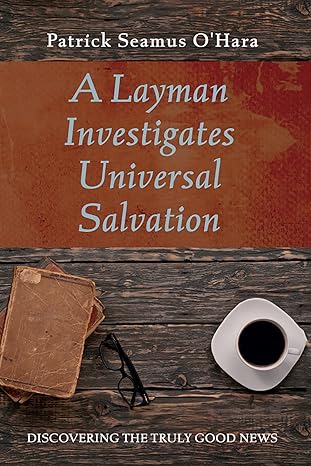
Further recommended reading.
“Very scholarly work for this layman. . . . I like the no-holds-barred but respectful approach to the history of the Western/Latin Church. The author demonstrates that he is well-read and provides tons of valuable and convincing citations. This work represents a fresh and interesting approach to the subject. Well worth reading.”
–Steve Lundgren, former Art Director, Wells Fargo
“Patrick O’Hara has given us a delightful and informative read. . . . With common (‘horse’) sense and an unapologetic earthiness, he traverses the history of critical issues at stake in the current and growing discussion over the eternal destiny of humanity. . . . I highly recommend this work as a worthy addition to your library–a great resource and a distinct voice in this all-important conversation!”
–Wayne Fair, Pastor and Founder of SovereignLove.org
 Muddling Through Life