
Let me say at the outset that it is an act of extreme hubris for a mere sinful layman to be critical one who is a saint in the Orthodox church. Nonetheless, after our parish priest posted the address of St. Mark to the Roman Catholic bishops assembled at the Council of Florence regarding the false teaching of Purgatory, I expressed my concerns/confusion with some of the things which St. Mark said. Fr. David responded by saying to me, “Question Authority always. Because if someone is an authority on something, you will be edified. If there is something about what you read that troubles you, let’s talk. But hopefully I can help clarify it. I think you’ll find it a healing teaching in its proper context.”
I’m not sure Fr. David is going to be ready for this. Of all the people in his parish, I easily image that I am his main problem child. Anyway, here we go. St. Mark’s discourse and my questions:
ST. MARK: “Because we are required, preserving our Orthodoxy and the Church Dogmas handed down by the Fathers, to answer with love to what you have said, as our general rule we shall first quote each argument and testimony which you have brought forward in writing, in order that the reply and resolution in each of them might follow briefly and clearly.
And so, at the beginning of your report you speak thus: “If those who truly repent have departed this life in love (towards God) before they were able to give satisfaction by means of worthy fruits for their transgressions or offenses, their souls are cleansed after death by means of purgatorial sufferings; but for the easing (or ‘deliverance’) of them from these sufferings, they are aided by the help which is shown them on the part of the faithful who are alive, as for example: prayers, Liturgies, almsgiving, and other works of piety.”
1. To this we answer the following: Of the fact that those reposed in faith are without doubt helped by the Liturgies and prayers and almsgiving performed for them, and that this custom has been in force from antiquity, there is the testimony of many and various utterances of the teachers, both Latin and Greek, spoken and written at various times and in various places.
But that souls are delivered thanks to a certain purgatorial suffering and temporal fire which possess such [purgatorial] power and has the character of a help — this we do not find either in the Scriptures or in the prayers and hymns for the dead, or in the words of the teachers.
But we have received that even the souls which are held in Hades are already given over to eternal torments, whether in actual fact and experience or in hopeless expectation of such, can be aided and given a certain small help, although in the sense of completely loosing them from torment or giving hope for a final deliverance.
And this is shown from the words of the great Macarius the Egyptian ascetic who, finding a skull in the desert, was instructed by it concerning this by the action of divine power. And Basil the Great, in the prayers read at Pentecost, writes literally the following: “Who also, on this all-perfect and saving feast, art graciously pleased to accept propitiatory prayers for those who are imprisoned in Hades, granting us a great hope of improvement for those who are imprisoned from the defilements which have imprisoned them, and that Thou wilt send down Thy consolation” (Third Kneeling Prayer at Vespers).:
EDWARD, THE SINNER: This appears to fly in the face of many troparia and kontakion in which we declare that Christ destroyed the gates of Hades. It intimates that Hades is no more, having been emptied of its woeful inhabitants who were awaiting the coming of the Redeemer. Did God somehow decide to rebuild it? Did He hire the construction firm of Augustine, Anselm & Aquinas to build Hades back up? (Sorry for the snark. Couldn’t help myself)
ST. MARK: “But if souls have departed this life in faith and love, while nevertheless carrying away with themselves certain faults, whether small ones over which they have not repented at all, or great ones for which — even though they have repented over them — they did not undertake to show fruits of repentance: such souls, we believe, must be cleansed from this kind of sins, but not by means of some purgatorial fire or a definite punishment in some place (for this, as we have aid, has not at all been handed down to us). But some must be cleansed in the very departure from the body, thanks only to fear, as St. Gregory the Dialogist literally shows; while others must be cleansed after the departure from the body, either while remaining in the same earthly place, before they come to worship God and are honored with the lot of the blessed, or — if their sins were more serious and bind them for a longer duration — they are kept in Hades, but not in order to remain forever in fire and torment, but as it were in prison and confinement under guard.
EDWARD, THE SINNER: First of all, as stated above, Hades is finished. Done.
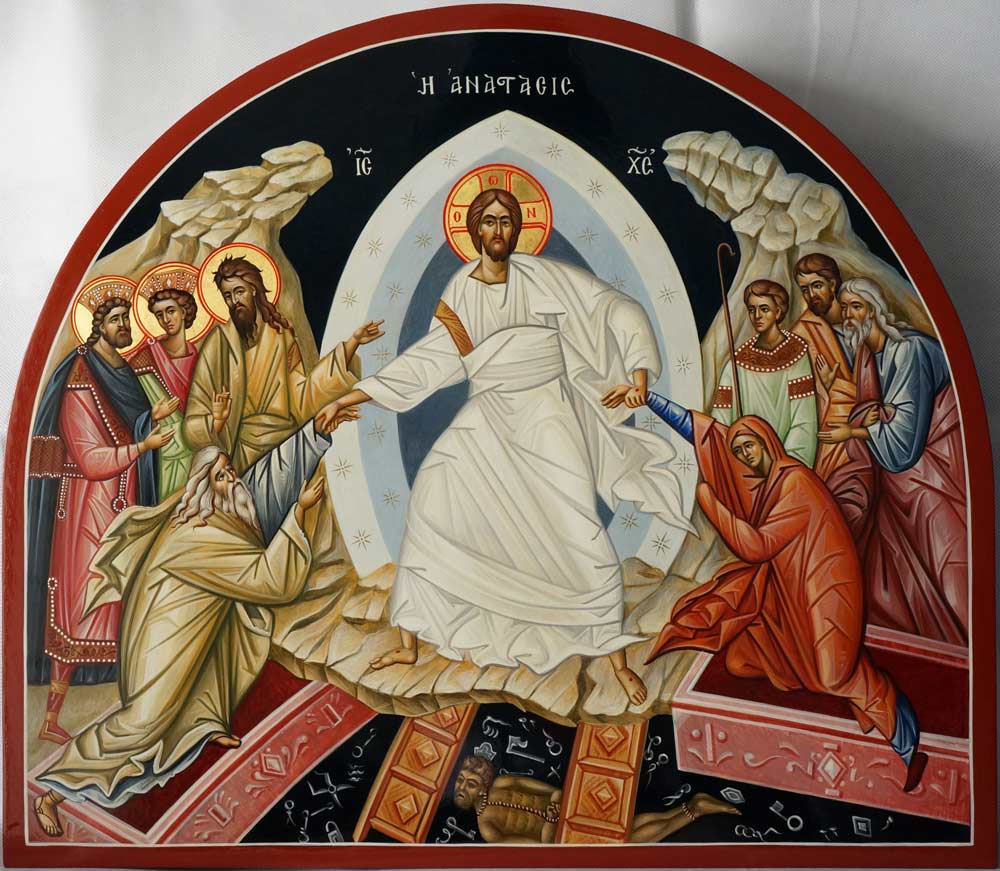
The gates of Hades are destroyed. In the icon of the Resurrection, we see Christ standing on the broken gates as He lifts Adam and Eve out of their graves. And look under the gates, which are under the feet of Christ. Death is trampled. “By death He trampled death.”
Secondly, if you are going to talk about a place, then for the love of Pete, get your description correct. When the Bible speaks of Hades, it is speaking of Sheol. It is the Greek word for the same understanding – the place of the dead. There is no fire in Hades. Let’s look at the common Jewish understanding of Sheol (Hades) which existed during the time of Christ:
FROM A JEWISH WEBSITE: “After a week of researching Sheol, which often gets translated as “Hell”, I thought I’d be feeling rather grim at the end of it all, but the word has actually given me a great amount of hope and positivity. That may sound strange, but by the time you’re finished reading this posting I hope you end up feeling the same way. Sheol is not hell . . . at least not in the sense of our present cultural interpretation of the place, ( MY NOTE: which is a place of eternal suffering and damnation, with fire and brimstone and torment, created by Roman Catholicism). Some suggest that Sheol simply means the grave, which seems to make sense, apart from the fact that there is another Hebrew word for “grave”: qehver (6913). However, having more than one word for grave shouldn’t be of concern; English is notorious for multiple words meaning the same thing: grave, tomb, sepulcher, cemetery plot, burial chamber . . . and it’s not the only language to do this.
What the Tanakh does make it clear, is that Sheol is not the place where evil people go. It’s just the place where everyone goes. Everyone dies and goes down to Sheol… even the patriarch Jacob knew he would go there, eventually. Here was his response after he heard that his son Joseph had died (although really, he had not):”
EDWARD, THE SINNER: Since St. Mark mentions fire and torment, which had no place in Hades in the Jewish understanding of the first century, this is a rather obvious clue that he has accepted the idea that Hades means “hell.” Well, it means no such thing. That’s like pointing to a cat and saying “dog.” The Greek understanding of Hades corresponds to the Jewish understanding of Sheol. Both mean “the place of the dead.” That’s it. Now there are more nuances to the idea of Hades than of Sheol. First of all, Hades does not mean a place. It is the name of the god who rules over the underworld. The name of the god who rules over it in Greek mythology has been transfixed onto the place of the dead itself. The underworld has within it numerous places where the dead go, depending upon the lives they have lived on earth. Tartarus is the place where the wicked are tormented. It is hard for me to believe that a brilliant Greek-speaking Christian such as St. Mark, an educated man, would so easily give in to the way that Roman Catholic soteriologists mashed Sheol, Hades, and Tartarus into one word – eternal hell, and give to that word a definition which flies in the face of the common understanding of Sheol and Hades.
ST. MARK: “All such ones, we affirm, are helped by the prayers and Liturgies performed for them, with the cooperation of the divine goodness and love for mankind. This divine cooperation immediately disdains and remits some sins, those committed out of human weakness, as Dionysius the Great (the Areopagite) says in the “Reflections of the Mystery of those Reposed in Faith” (in The Ecclesiastical Hierarchy, VII, 7); while other sins, after a certain time, by righteous judgments it either likewise releases and forgives — and that completely — or lightens the responsibility for them until that final Judgment. And therefore we see no necessity whatever for any other punishment or for a cleansing fire; for some are cleansed by fear, while others are devoured by the gnawing of conscience with more torment than any fire, and still others are cleansed only the very terror before the divine glory and the uncertainty as to what the future will be. And that this is much more tormenting and punishing than anything else, experience itself shows, and St. John Chrysostom testifies to us in almost all or at least most of his moral homilies, which affirm this, as likewise does the divine ascetic Dorotheus in his homily ‘On the Conscience.’”
EDWARD, THE SINNER: Why is the immense love of God, unfathomable beyond our comprehension, able to disdain and remit only some sins? Why not disdain and remit all of them for all people of all times? This seems to put the love of God on a sliding scale which allows for St. Mark and those of similar thought to keep alive the prospect of sinners going into eternal torment by believing something similar to the Roman idea of “mortal and venial sins.” Some sins God overlooks and forgives, while others He casts into hell?
ST. MARK: “2. And so, we entreat God and believe to deliver the departed from eternal torment, and not from any other torment or fire apart from those torments and that fire which have been proclaimed to be forever. And that, moreover, the souls of the departed are delivered by prayer from confinement in Hades, as if from a certain prison, is testified, among many others, by Theophanes the Confessor, called the Branded (for the words of his testimony for the Icon of Christ, words written on his forehead, he sealed by blood). In one of the canons for the reposed he thus prays for them: “Deliver, O Savior, Thy slaves who are in the Hades of tears and sighing” (Octoechos, Saturday canon for the reposed, Tone 8, Canticle 6, Glory).”
EDWARD, THE SINNER: Hold on there!! I have been taught that the belief in Orthodoxy is that once you die, you are assigned a waiting place of either bliss or sorrow which corresponds to your final destiny! In other words, once you are dead, that’s it! No repentance, no chance for change, no getting out of the place that your behavior on earth has finalized for you. It’s done. You are finished. And now, here is St. Mark stating that “we entreat God and believe to deliver from eternal torment.” I am obviously misunderstanding this. Either you are in the waiting place, and the only thing to be determined is how bad it is going to be for you, or there is yet a Last Judgment to come at which time it will then be determined where you are assigned as a final resting place, either Paradise or Hell. So iif the unrighteous are already in the Hades of condemnation, simply waiting the Last Judgment to see just how bad it will be, then how can the prayers of the righteous change that which has already been determined?
ST. MARK: “Do you hear? He said “tears” and “sighing,” and not any kind of punishment or purgatorial fire. And if there is to be encountered in these hymns and prayers any mention of fire, it is not a temporal one that has a purgatorial power, but rather that eternal fire and unceasing punishment. The saints, being moved by love for mankind and compassion for their fellow countrymen, desiring and daring what is almost impossible, pray for the deliverance and daring what is almost impossible, pray for the deliverance of those departed in faith. For thus does St. Theodore the Studite, the confessor and witness of the truth himself, say, at the very beginning of his canon for the departed: “Let us all entreat Christ, performing a memorial today for those dead from the ages, that He might deliver from eternal fire those departed in faith and in hope of eternal life” (Lenten Triodion, Meat-Fare Saturday, Canon, Canticle 1). And then, in another troparion, in Canticle 5 of the Canon, he says: “Deliver, O our Savior, all who have died in faith from the ever-scorching fire, and unillumined darkness, the gnashing of teeth, and the eternally-tormenting worms, and all torment.’”
EDWARD, THE SINNER: And furthermore, why do those who have departed in the faith have to be pray for to be delivered from eternal torment? They are SAVED! The work of Christ on the Cross is a one-time finished work which has restored all mankind to God (Romans 5: 18-19). Oh, I get it! It’s not really about Christ alone being Savior, but about how we EARN our salvation, so that even if I have professed the Orthodox and true faith, perhaps I haven’t done quite enough to EARN my salvation and thus I need extra prayers for deliverance, lest in the end I will be lost anyway!
Lest you think I protesteth too much, here is a quote from one of our beloved miracle working saints of Mount Athos;
“Let us struggle with all our powers to gain Paradise. The gate is very narrow, and don’t listen to those who say that everyone will be saved. This is a trap of Satan so that we won’t struggle.”
This is a horrifying idea to those of us who are dysfunctional perfectionists, who have been raised by parents who could never be pleased, no matter what we did, and who have transferred this to God. He becomes the Parent who is never pleased and for whom we can never do enough to make Him pleased. And despite every effort of priests and counselors to disavow us of this thinking, it remains ever in the back of the mind and the depths of the heart. This constant need to be perfect is like the ink stains that old-fashioned fountain pens would leave on the pocket of a shirt – IT AIN’T COMING OUT!! Oh, you can fade that stain, but it is always there, telling you that you are not good enough and no matter what you do, you are a failure and will not be accepted. This, in turn, terrifies the sinner who is psychologically handcuffed by these thoughts, waiting for the day that he will hear the final words of condemnation because he was never quite good enough to deserve or earn salvation.
And yet, the same Lenten hymns speak of the all-encompassing love of God, that Christ died for all mankind, not for just a few, but for all. The Lenten and Resurrection hymnody is filled with expressions of an all-encompassing salvation which destroys Hades and gives resurrection to all because Christ is the Savior of the world:
Thy virginal womb which gave birth to Christ hath destroyed the ancient pasture of the slayer of mankind; wherefore, all creation now rejoiceth, O most pure one, having been restored to life, with one accord hymning thy Son and God.
All ye His creation rejoice! * let the heavens be glad, * let the nations clap their hands with gladness; * for Christ our Savior hath nailed our sins to the Cross * and by slaying death hath granted us life eternal, * raising all of the fallen race of Adam, ** as He alone is the Lover of mankind.
Look, you can’t have it both ways. This is what drives me a little bit nuts every Lent. If there is a final place of eternal misery for sinners, then we are wrong to sing about Christ dying for all, about Hades being destroyed, about all creation rejoicing, and the fallen race of Adam being redeemed. And it is hardly Good News for the majority (some have averred up to 95%) of all humanity.
ST. MARK: “Where is the “purgatorial fire” here? And if it in fact existed, where would it be more appropriate for the Saint to speak of it, if not here? Whether the saints are heard by God when they pray for this is not for us to search out. But they themselves knew, as did the Spirit dwelling in them by Whom they were moved, and they spoke and wrote in this knowledge; and likewise the Master Christ knew this, Who gave the commandment we should pray for our enemies, and Who prayed for those who were crucifying Him, and inspired the First Martyr Stephen, when he was being stoned to death, to do the same. And although someone might say that when we do everything that depends on us. And behold, some of the saints who prayed not only for the faithful, but even for the impious, were heard and by their prayers rescued them from eternal torment, as for example the first Woman-Martyr Thecla rescued Falconila, and the divine Gregory the Dialogist, as it is related, rescued the Emperor Trajan.
EDWARD, THE SINNER: Certainly God gives us great opportunity to show His love by our taking the time and effort to pray for those who have gone before us in death, both friends and enemies, strangers and family. But if our weak and sinful efforts on behalf of the dead can have such a salutary effect as to even lift a sinner out of eternal torment, then what of God Himself? Is His love so truncated that He will not do all that He can to save all mankind, with or without the prayers of the faithful? This sort of thinking makes God sound, in my opinion, stingy and without mercy. Are you really inferring that sinful human beings are more loving than God Himself?
ST. MARK: “4. After this, a little further on, you desired to prove the above-mentioned dogma of purgatorial fire, at first quoting what is said in the book of Maccabees: “It is holy and pious . . . to pray for the dead . . . that they might be delivered from their sin” (2 Maccabees 12:44-45). Then, taking from the Gospel according to Matthew the place in which the Savior declares that “whosoever shall speak against the Holy Ghost, it shall not be forgiven him, either in this world, nor in that which is to come” (Matt. 12:32), you say that from this one may see that there is remission of sins in the future life.
But that from this there in no way follows the idea of purgatorial fire is clearer than the sun; for what is there in common between remission on one hand, and cleansing by fire and punishment on the other? For if the remission of sins is accomplished for the sake of prayers, or merely by the divine love of mankind itself, (MY COMMENT: Indeed, this is the whole basis of Universalism!!) there is no need for punishment and cleansing by fire. But if punishment, and also cleansing, are established by God , , , then, it would seem, prayers for the reposed are performed in vain, and vainly do we hymn the divine love of mankind. And so, these citation are less a proof of the existence of purgatorial fire than a refutation of it: for the remission of sins of those who have transgressed is presented in them as the result of a certain royal authority and love of mankind, and not as a deliverance from punishment or a cleansing.
EDWARD, THE SINNER: I have never quite understood how the remission of another’s sins is accomplished by my prayers. First of all, this is hardly covenantal theology. Covenants are relational, not legal. In a covenant relationship, if I offend, I am the one who must approach the offended and obtain restoration of that union by confessing and seeking forgiveness. Now, if I am a friend to both parties, I might incline the offended party to open his heart to reconciliation, but even in that, the offender still must approach the offended in contrition in order to restore unity. I can even have the offended to say, “I have already forgiven him” (which in Christ, God has already done) but the joy of friendship and unity is still unrepaired until confession and apology is tendered by the offender. Do you see the picture here? And how do I open the heart of He who is love itself any wider than it already is? The Father stands on a hillside, looking off into the distance, for the return of His prodigal sons and daughters. Orthodoxy teaches that He is no angry, implacable God who must be entreated with tears to consider forgiving another by the prayers of a mutual friend. He waits to forgive, and indeed has already forgiven. I’m sorry to say this of a saint, but he is, nonetheless, a human being and subject to error, and I can’t help but feel that St. Mark has deeply drunk of the well of God’s wrath from the cultural milieu of Roman Catholicism which dyed the world in the stain of an angry God just waiting to cast sinners into the fire. Think Dante.
And the worst part of this is that this thinking, which is so opposed to Orthodoxy (in which I first heart the lovely phrase “For thou art a God who LOVES MANKIND!”) has imbued all of Western Christianity with its poisonous idea of the bitter and vengeful God who is just waiting – not to forgive, as the Father of the Prodigal, but to condemn and punish. Having been raised and poisoned myself in this thinking for over fifty years, it is not easily jettisoned. Combine that with the ever-present perfectionist in my mind who whispers “You are not doing enough. He is not pleased with you. He is going to judge you and cast you into hell.” and you have a recipe for one really screwed up human being.
ST. MARK: “5. Thirdly, (let us take) the passage from the first epistle of the Blessed Paul to the Corinthians, in which he, speaking of the building on the foundation, which is Christ, “of gold, silver, costly stones, wood, hay, stubble,” adds: “For that day shall declare it, because it is revealed in fire; and the fire itself shall prove each man’s work of what sort it is. If any man’s work shall abide which he built thereon, he shall receive a reward. If any man’s work shall be burned, he shall suffer loss: but he himself shall be saved, yet so as through fire” (1 Cor. 3:11-15). This citation, it would seem, more than nay other introduces the idea of purgatorial fire; but in actual fact it more than any other refutes it.
First of all, the divine Apostle called it not a purgatorial but a proving (fire); then he declared that through it good and honorable works also must pass, and such, it is clear, have no need of any cleansing; then he says that those who bring evil works, after these works burn, suffer loss, whereas those who are being cleansed not only suffer no loss, but acquire even more; then he says that this must be on “that day”, namely, the day of Judgment and of the future age, whereas to suppose the existence of a purgatorial fire after that fearful Coming of the Judge and the final sentence—is this not a total absurdity? For the Scripture does not transmit to us anything of the sort, but He Himself Who will judge us says: “And these shall go away into eternal punishment, but the righteous into eternal life” (Matt. 25:46):”
EDWARD, THE SINNER: Once again, I ask, how is it that a Greek speaking believer gives in to the interpretation of the word “aionios” as meaning eternal? And furthermore, in Matthew 25:46, the phrase in Greek is “aionios kolasis” (αἰώνιος κόλασις) which means “age-lasting correction”. Correction – NOT PUNISHMENT! 1 This is what happens when your understanding and interpretation of the Scriptures is agenda driven, rather than faithful to the whole of the ancient faith. As I mentioned before, Universalism was a majority belief in the Early Church up until Augustine and then Justinian began to attack and dismantle it. I am disturbed that the Roman Catholic, law-and-punishment cultural milieu of that empire so easily displaced in the East the God of love and restoration with the God who seeks legal judgment and eternal punishment of those who have fallen.
ST. MARK: and again: “They shall come forth: they that have done good, unto the resurrection of life, and they that have done evil, unto the resurrection of judgment (John 5:29). Therefore, there remains no kind of intermediate place; but after He divided all those under judgment into two parts, placing some on the right and others on the left, and calling the first “sheep” and the second “goats” — He did not at all declare that there are any who are to be cleansed by that fire. It would seem that the fire of which the Apostle speaks is the same as that of which the Prophet David speaks: “Fire shall blaze before Him, and round about Him shall there be a mighty tempest (Ps. 49:4); and again: “Fire shall go before Him, and shall burn up His enemies round about (Ps. 96:3). Daniel the Prophet also speaks about this fire: “A stream of fire issued and came forth from before Him (Daniel 7:10).
EDWARD THE SINNER: This is also agenda-driven selective choosing of what you want to see to prove your point. Our Lord very much DID state that there would be a fire of cleansing for the unclean soul. Matthew 13: 42 speaks of the ” kalminos pyr ” (κάμινος πῦρ) the “furnace of fire.” If you look up the definition of kalaminos, it is specifically a smelting furnace. Smelting is a cleansing process! I cannot help but think that the Judgment is not one of condemnation, but of just how much smelting is going to be required to cleanse the soul. And look at what St. Mark says below:
ST. MARK: Since the saints do not bring with them any evil work or evil mark, this fire manifests them as even brighter, as gold tried in the fire, or as the stone amianthus, which, as it is related, when placed in fire appears as charred, but when taken out of the fire becomes even cleaner, as if washed with water, as were also the bodies of the Three Youths in the Babylonian furnace. Sinners, however, who bring evil with themselves, are seized as a suitable material for this fire and are immediately ignited by it, and their “work,” that is, their evil disposition or activity, is burned and utterly destroyed and they are deprived of what they brought with them, that is, deprived of their burden of evil, while they themselves are “saved” – that is, will be preserved and kept forever, so that they might not be subjected to destruction together with their evil.”
EDWARD, THE SINNER: WOW!! This is the most Universalist thing that St. Mark could have possibly said. It is right in line with Universalist thought, that the evils which populate our souls at death will be cleansed by the fire of God’s love. Read that again carefully. “Their evil disposition is destroyed.” These are the sinful of all kinds, from the notorious Adolph Hitler to the child who stole a cookie, knowing it to be wrong. “ . . . deprived of their burden of evil, while they themselves are SAVED.” This statement just stuns me. Did St. Mark realize what this statement of his inferred, especially after his earlier condemnation of Origen and St. Gregory of Nyssa?
ST. MARK: “6. The divine Father Chrysostom also (who is called by us “the lips of Paul,” just as the latter is “the lips of Christ”) considers it necessary to make such an interpretation of this passage in his commentary on the Epistle (Homily 9 on First Corinthians); and Paul speaks through Chrysostom, as was made clear thanks to the vision of Proclus, his disciple, and the successor of his See. St. Chrysostom devoted a special treatise to this one passage, so that the Origenists would not quote these words of the Apostle as confirmation of their way of thought (which, it would seem, is more fitting for them than for you), and would not cause harm to the Church by introducing an end to the torment of Hades and a final restoration (apokatastasis) of sinners. For the expression that the sinner “is saved as through fire” signifies that he will remain tormented in fire and will not be destroyed together with his evil works and evil disposition of soul.
EDWARD, THE SINNER: Here is yet another apparently contradictory statement. If the sinner is “saved as through fire,” then how does he remain tormented in the fire? Such remaining in the fire would serve absolutely no purpose whatsoever for one who is saved! The evil has been, according to St. Mark’s earlier statement, burned away. He has been “deprived of his burden of evil.” therefore, he is no longer a sinner per se, but is now in the first steps of restoration to that for which God created him – holiness and union with God, i.e. theosis.
And how would the teaching of Apokatastasis “harm the Church?” Apocatastasis was a popular teaching in the first five hundred years of the Church, particularly in the East. Yet the Church grew by leaps and bounds. Explain to me the harm that was done by the “indeed very many” (immo quam plurimi), of whom Augustine spoke, meaning that it was a “vast majority” (Ramelli, Christian Doctrine, 11). Why did Orthodoxy bow to Rome and trash this teaching over the next couple of centuries? And make no mistake, it was the thinking of the Roman empire that prevailed. It was not an Eastern saint who began the dismantling of Universalism, but Augustine. And it was Justinian who, for political reasons, put that destruction on jet skis and turned it loose. From a quote from Justinian himself, 2 we know that the purpose of teaching eternal hell was the terrorizing of the peasants to keep them in line. And Rome picked up on this idea and carried it even further, as evidenced by the wretched ideas found in Dante’s description of the levels of hell and the tortures found there, tortures that only a profoundly sadistic mind would create and impose as punishments.
ST. MARK: Basil the Great also speaks of this in the “Morals,” in interpreting the passage of Scripture, “the voice of the Lord Who divideth the flame of fire” (Ps. 28:7): “The fire prepared for the torment of the devil and his angels, is divided by the voice of the Lord, so that after this there might be two powers in it: one that burns, and another that illumines: the tormenting and punishing power of that fire is reserved for those worthy of torment,; while the illumining and enlightening power is intended for the shining of those who rejoice. Therefore the voice of the Lord Who divides and separate the flame of ire is for this: that the dark part might be a fire of torment and the unburning part a light of enjoyment” (St. Basil, Homily on Psalm 28)
EDWARD, THE SINNER: This is Basil’s OPINION. I believe he is influenced, like many other Fathers, by the Roman teaching of law and punishment. Yes, it is perhaps an act of extreme hubris to criticize the teaching of a saint, but in turn, you must prove to me that the saints are infallible in their understanding of spiritual matters, or that they are recipients of special divine revelation. I don’t find anywhere in Scripture this separation of the fire of God into separate components – one illuminating and one punishing. What I do find is the fire of God as purgative, restorative, and healing. 3 This is nothing less than reading into the text what you wish to believe. It is common, and we all are subject to do this.
ST. MARK: And so, as may be seen, this division and separation of that fire will be when absolutely everyone will pass through it: the bright an shining works will be manifest as yet brighter, and those who bring them will become inheritors of the light and will receive the eternal reward; while those who bring bad works suitable for burning, being punished by the loss of them, will eternally remain in fire and will inherit a salvation which is worse than perdition, for this is what, strictly speaking the word “saved” means — that he destroying power of fire will not be applied to them and they themselves be utterly destroyed.
EDWARD, THE SINNER: Now wait just a second! You just finished a statement which contradicts this. Let’s review, shall we?
“Sinners, however, who bring evil with themselves, are seized as a suitable material for this fire and are immediately ignited by it, and their “work,” that is, their evil disposition or activity, is burned and utterly destroyed and they are deprived of what they brought with them, that is, deprived of their burden of evil, while they themselves are “saved”–that is, will be preserved and kept forever, so that they might not be subjected to destruction together with their evil.”
You just finished saying that sinners will be cleansed of their evil disposition or activity, deprived of their burden of evil, so that they will be preserved and kept forever, not subject to destruction together with their evil. You see, contradictions like this make me feel that even the saints are not above questioning.
ST. MARK: “Following these Fathers, many other of our Teachers also have understood this passage in the same sense. And if anyone has interpreted it differently and understood “salvation” as “deliverance from punishment,” and “going through fire” as “purgatory” — such a one, if we may so express ourselves, understands this passage in an entirely wrong way. And this is not surprising, for he is a man, and many even among the Teachers may be seen to interpret passages of Scripture in various ways, and not all of them have attained in an equal degree the precise meaning. It is not possible that one and the same text, being handed down in various interpretations, should correspond in an equal degree to all the interpretations, should correspond in an equal degree to all the interpretations of it; but we, selecting the most important of them and those that best correspond to church dogmas, should place the other interpretations in second place. Therefore, we shall not deviate from the above-cited interpretation of the Apostle’s words, even if Augustine or Gregory the Dialogist or another of of your Teachers should give such an interpretation; for such an interpretation answers less to the ideas of a temporary purgatorial fire than to the teaching of Origen which, speaking of a final restoration of souls through that fire and a deliverance from torment, was forbidden and given over to anathema by the Fifth Ecumenical Council, and was definitively overthrown as a common impiety for the Church.
EDWARD, THE SINNER: This is also not true. The Fifth Council did not address Apokatastasis specifically or by name. The fifteen canons which did supposedly did mention it by name were illegitimately added by Emperor Justinian for political reasons. Justinian was not a bishop and greatly overstepped his bounds by insisting on the addition of these canons. Fr. Aiden Kimel has done a legendary job of research on the illegitimate nature of these additional canons, and modern scholarship has shown them to be bogus, so much so that the Catholic Encyclopedia Online refuses to list them with the list of the canons of the Fifth Council. Fr. Kimel’s work on this, if you are interested learning more about this rather controversial council, can be found here:
And tell me how this is an “impiety for the Church?” I am aghast that men would consider such truly Good News to be somehow an impious statement, as if God creating sentient beings for no other purpose than their eternal misery is somehow a pious and noble act!!
(In Chapter 7 through 12, St. Mark answers objections raised by quotations from the works of St. Augustine, St. Ambrose, St. Gregory the Dialogist, St. Basil the Great, and other Fathers, showing that they have been misinterpreted or perhaps misquoted and that these Fathers actually teach the Orthodox doctrine, and if not, then their teaching is not to be accepted. Further, he points out that St. Gregory of Nyssa does not teach about “purgatory” at all, but hold the much worse error of Origen, that there will be an end to the eternal flames of Hades — although it may be that these ideas were placed in his writings later by Origenists.)
Worse error? That God, who is great in mercy and abundant in love and forgiveness, would actually die for all mankind? That all would be brought to salvation?
ST. MARK: 13. And finally you say: “The above-mentioned truth is evident from the Divine Justice, which does not leave unpunished anything that was done amiss, and from this it necessarily follows that for those who have not undergone punishment here, and cannot pay it off either in heaven or in Hades, it remains to suppose the existence of a different, a third place in which this cleansing is accomplished, thanks to which each one, becoming cleansed, it immediately led up to heavenly enjoyment.”
To this we say the following, and pay heed how simple and at the same time how just this is: it is generally acknowledged that the remission of sins is at the same time also a deliverance from punishment; for the one who receives remission of them at the same time is delivered form the punishment owed for them. Remission is given in three forms and at different times: (1) during Baptism; (2) after Baptism, through conversion and sorrow and making up (for sins) by good works in the present life; and (3) after death, through prayers and good deeds and thanks to whatever else the Church does for the dead.
EDWARD, THE SINNER: I still don’t understand how prayers and good deeds remit sins. Someone has to explain this to me as if I am a five year old (in other words, keep it simple, straight, and understandable!).
ST. MARK: Thus, the first remission of sins is not at all bound up with labor; it is common to all and equal in honor, like the pouring out of light and the beholding of the sun and the changes of the seasons of the year, for this grace alone and of us is asked nothing else but faith. But the remission is painful, as for one who “every night washes his bed, and with tears waters his couch” (Ps. 6:5), for whom even the traces of the blows of sin are painful, who goes weeping and with contrite face and emulates the conversion of the Ninevites and the humility of Manasses, upon which there was mercy. The third remission is also painful, for it is bound up with repentance and a conscience that is contrite and suffers from insufficiency of good; however, it is not at all mixed with punishment, if it is a remission of sins; for remission and punishment can by no means exist together. Moreover, in the first and last remission of sins the grace of God has the larger part, with the cooperation of prayer, and very little is brought in by us. The middle remission, on the other hand, has little from grace, while the greater part is owing to our labor. The first remission of sins is distinguished from the last by this; that the first is a remission of all sins in an equal degree, while the last is a remission only of those sins which are not mortal and over which a person has repented in life.
EDWARD, THE SINNER: This sounds more like Roman Catholicism than ancient Orthodoxy, especially in the use of the wording of “sins which are not mortal.” When I was talking about and studying Orthodoxy online, prior to my conversion, I was told that in Orthodoxy, we do not refer to sins as “mortal” and “venial.” Was I misinformed? And from where does St. Mark get the idea of “three remissions” of sins? I don’t find that in the Scriptures anywhere. Forgive me for saying this, but it seems to me that over the course of the history of the Church, certain “pious ideas,” along with folklore, such as the “Ariel Toll-Houses,” have been thrown into the Church and accepted as dogma when they have no such backing from Scripture or Holy Tradition. It appears that some men put their ideas into the writings of the Church, and unless they were way out of bounds, such as the insanity of Arianism, these ideas have been accepted without question. Then someone like me comes along and says “WHAT????” and for asking such a question, catches hell for daring to ask.
ST. MARK: Thus does the Church of God think and when entreating for the departed the remission of sins and believing that it is granted them, it does not define as a law of punishment with relation to them, knowing well that the Divine Goodness in such matters conquers the idea of justice.
EDWARD, THE SINNER: In closing, let me say this: Even though I am wrestling with certain ideas in Orthodoxy, where else am I going to go? Back to crazy, splintered, and man-made Protestantism, which cannot be found in the Early Church? Back to the Catholic Church I left, seeking to worship and believe like the Early Church without the additions that came after the lamentable schism of 1054AD? Not on your life! I am convinced that Orthodoxy is truth, but that truth has a boundary – the canons of the Seven Ecumenical Councils. Private thoughts, visions, etc., are not, as I understand it, binding on my conscience and therefore subject to my examination and analysis. I have read warnings given by the saints of Mount Athos against desiring, seeking, or blindly accepting visions and other phenomena. The address to the council by St. Mark, while clear and accurate in condemnation of the false idea of Purgatory, is nonetheless worded in certain understandings of his own study, and not the binding statements of an ecumenical council. Thus, I should be free to, as I have done, look at certain parts of this address and raise concerns over the accuracy of what he said. He was, even as one declared a saint, a man, and subject to the influences of the surrounding culture 4 as well as, personal issues and subjectivism, as we all are,
- To understand kolasis in Universalism, consider these key points:
1. Kolasis refers to the concept of corrective punishment or discipline in the afterlife.
It is often associated with the belief that all souls will eventually be reconciled with God.
2. Universalism posits that divine love ultimately leads to the salvation of all beings.
3. Kolasis serves as a means of spiritual growth and purification for the soul.
4. This concept contrasts with traditional views of eternal damnation, emphasizing hope and restoration.
5. Universalists argue that kolasis reflects God’s justice and mercy, ensuring no soul is lost forever. ↩︎ - “Will render men slothful, and discourage them from keeping the commandments of God. It will encourage them to depart from the narrow way, leading them by deception into ways that are wide and easy.”
There was a reason that Justinian could not allow men to not keep “the commandments of God” (which in reality, understanding what was happening in the empire at that time, were the commandments of Justinian). The empire was being torn apart by dissention. Riots were breaking out in Jerusalem, with many dead, over theological ideas, including the acrimonious arguments between the pro and anti-Chalcedonian factions. Justinian was trying to restore the empire to its former glory, by warring against pagans who had taken Roman land, and by theologically uniting the empire. The idea of Universal Restoration could very well make men less than obedient to him, therefore, the fear of an eternal hell for the disobedient must be used as a tool to keep men in line with what Justinian wanted. In short, both Constantinople II and his edicts against Universalism appear to be more political in nature than theological. ↩︎ - Malachi 3:2-3; Isaiah 4:4; Matthew 13: 42 & 52; Hebrews 12:29; 1 Corinthians 3:13-15; 1 Peter 1:7 ↩︎
- It is no secret that the Eastern Fathers were highly influenced by Greek thinking. Certain of Greek cultural practices even find their way into the Divine Liturgy. For instance, after we sing the Cherubic Hymn at the Great Entrance, we sing “That we may receive the King of all, escorted invisibly by the angelic hosts.” I was told this was a reference to kings of that time being received back in victory, escorted by their army. ↩︎
 Muddling Through Life