
I ended Part Two of my conversation with Father M by trying to clarify exactly what he meant in saying that Holy Orthodox also believes in Apokatastasis (the Restoration of all things – which includes the salvation of all people). Father M expressed the idea that yes, God will bring all souls to Himself, but not all souls are going to either want or like it. And this state goes on for eternity (hence, it is eternal torment). To which I would replay, that is not restoration of all things! Far from it, and certainly not what the Fathers of the Church taught when they taught it.
From there we engaged in a bit more conversation which I share now:
Father M: not only that, but after the Last Judgment, you experience time more like God does. you can’t repent since there is no more successive time. so if you take your rebellious, God-hating self into eternity, there can be no change after that.
(Skip over a couple of posts which are not germane to the discussion)
Father M: the problem is that universalism isn’t everyone repenting in the end and being saved, it’s that everyone will be saved no matter how repentant they are. (The problem is that Father is wrong about this. Patristic Universalism teaches that all will be with Christ after they repent – some repent in this life (thus avoiding fiery punishment for their sins) and some in the next life (experiencing God’s love as the torment of punishment which both chastises and enlightens them so that they do come to repentance)
ME: Well, actually, the soteriology behind our thinking (i.e. all go to be with Christ/God. The repentant love it, the wicked hate it) is that all really are saved. It just boils down to what we do in the here and now with that salvation freely given to all mankind. Those who repent in this life will find the next life and the presence of God to be bliss. Those who don’t – won’t.
Which does lead me to my next question. Your position (and I assume the position of Orthodoxy as a whole) is that once the Last Judgment is done, that’s it. There is no further opportunity of repentance.
Does this mean that before the Last Judgment, there is opportunity for those who are in the next life (hell, Hades, whatever it is properly called) to repent and turn to God asking for forgiveness?
Father M: sort of. the prayers of the Church can certainly relieve the departed in hades before the Last Judgment, but also God can send someone to torment for a while, only for them to be saved in the end.
ME: Still working on understanding. As you understand it, Hades and hell are essentially describing the same state of being, or is hell the final place of the damned and Hades is kind of a waiting place where the wicked go and get a foretaste of the Last Judgment? I think I remember reading something that you or someone else here said about this, that before the Last Judgment, the soul gets a sense of where it is ultimately headed.
Is all that correct?
Father M: yes, but there is hope for those in hades. (Okay. So as Father sees it – and he says this is Othodox thinking – Hades is the waiting place where there are millions of souls now who await the Last Judgment)
ME: Which is why our prayers for the deceased are so important. Okay, so what changes between Hades and the Final Judgment that makes repentance impossible? And what proof do you have of this?
Father M: the Resurrection is what changes. that’s when all of creation gets deified.
ME: I’ve been trying to wrap my mind around this answer. I still don’t see what changes after the Resurrection that would make repentance impossible. Can you give me a bit more detail as to why you think this is so?
Father M: because when Christ is all and in all, we experience time as He does which is not successively. no successive time, no repentance. we all, by grace experience time as God does, which is eternal. (Father does not see the blind spot in this argument. If Christ is to be “all in all,” then Universalism must be true. If there are millions and millions of souls existing in a state of anguish, anger, torment, and hatred of God, and that for all eternity, then how is Christ all in all? Christ is certainly not all for them.)
ME: I would respectfully disagree. To experience time as Christ does would make us equal to God, and we are created beings. Time is, as I have read on a philosophical site, a part of having potentiality. Since there is no potentiality with God, He being perfect and without potentiality, He is above time and without time. But we are created beings with potential, therefore, we experience the passage of time as part of the change involved with potentiality. And since we will never be God, but always be learning of Him in ever-deepening truth of His love, yet never achieving equality of essence, then there will be time in the next life for us.
And without time, there are no songs in heaven. With out time, you are stuck in one note, one word, one moment without movement from one note to another. It is almost like the “ooooooom” of the Buddhists, a single note going on forever. There can be no conversation either.
No, I have sincere doubts that we will experience time as God does because we are not and never will be essentially God.
Father M: well, no. we’d only be equal with God if we experienced time as God does by nature. but since it’s by grace, we aren’t equal. and no, experiencing time as God does doesn’t mean static or one note for creatures. you’re conflating modern philosophy with theology. ( I still don’t understand how you can sing or talk without going from one note to another or one word to another)
ME: A little more explanation, if you would be so kind.
Father M: you referenced a philosophy site, and I know some Aquinas when I read it. that’s not theology.
ME: Hahahahaha!!! Good catch!!! Now please ‘splain the difference!!!
Father M: philosophy is man speculating and trying to make an argument for God.
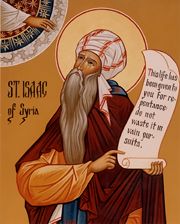
theology is experiencing and knowing God personally. (Uh huh! And this is where it gets interesting. St. Isaac of Ninevah, famed as a holy man and teacher, taught Apokatastasis. Where would he have gotten such ideas? Also, according to OrthoWiki: “Two great artesian wells of mystical experience, upon which Orthodox Byzantine mysticism drew in its first phase, were Saint Gregory of Nyssa and the monk Evagrios Pontikos (345-399 AD)”
St. Gregory of Nyssa is also among those who taught Apokatastasis.
ME: Ah ha! So philosophy is similar to theologumen! (theological opinions) As for experiencing God personally, how does Scripture and Holy Tradition fit in with all that? One can have experiences which are nothing more than prelest (prelest means deception), and these seem rather common in certain circles.
Father M: Scripture and Holy Tradition are the written account of those who have experienced God directly. (Such as St. Paul, who wrote that God will have mercy on ALL in Romans?) prelest happens when you don’t test the experience you get.
And what of the Holy Tradition of the first five centuries, when there existed three theological schools which taught Apokatastasis? How do you answer that, Father? Were they also all in prelest, or did the prelest start with Augustine and his wretched anthropology which saw men as totally depraved and deserving not healing, but hell? Father M appears to wish to embrace the Holy Tradition which fits his personal understanding of the next life and blow off the writings of men who were closer in time to Christ than Augustine, and much, much closer than the philsophical musings of men like Anselm of Canterbury, Thomas Aquinas, Dante, and the whole host of Roman Catholic writes who appear to revel and rejoice in the damnation of multitudes of souls.
I personally believe that Father has stepped on a theological land mine here and doesn’t realize it. Apokatastasis was indeed in the Holy Tradition of the Church for the first five centuries, and it is quite telling that for such an important issue as men’s eternal destiny, there was not one single ecumenical council called to question this teaching in five hundred years!
NOT ONE!
This is because Apokatastasis is also in line with the divinely inspired writings of St. Paul where he said that God will have mercy on all (Romans 11:32), that Jesus died for all (2 Corinthians 5: 14-15), that in Christ all are reconciled to God (Colossians 1:20), and that God will have all to be saved (1 Timothy 2:4). So we do have the testimony of both Sacred Scripture and Holy Tradition (until Augustine and Justinian took a wrecking ball to it) to stand on.
So here is the bottom line: according to Father M, the teaching of Orthodoxy is that after the Last Judgment, a soul in the next life finds it impossible to repent. Yet he offers no proof of this at all, which means that to me, this is just theologumen.
What does speak to me from Scripture, which source Father will accept, is this:
God is love and love wins!


“Christ will be all and in all” certainly sounds like Apokatastasis. So does so much of what St. Paul writes. It is really strange the opposition to Apokatastasis. That some remain unconvinced, thinking it might be possible for men to irrevocably or everlastingly reject Christ – I can understand. I can even understand that someone might be rather certain that it is possible for at least some people to damn themselves – to completely and unchangingly hate. But to think that it is important for other Christians to be certain of it? To teach it as something it is important to believe? To think it is the only thing that makes sense, and that the New Testament supports it without any tension? To think it somehow does harm to believe that Christ will redeem all and all will repent? Those things make no sense at all.
If someone hates, intends to hate forever, believes he will hate and suffer in his hate forever, his suffering – his hell – might seem like “Forever”.
LikeLike
Thanks for continuing to read my little musings on this subject, Rainia.
There are a number of factors which lend themselves to not being able to believe that souls will be able to come to repentance in the next life. Certainly I struggle with one of them, which is my observation of just how determined some people are to do evil, even after being rebuked and taught over and over and over again. Such behavior causes the mind to think of such people as being hardened beyond any and all repentance, either in this world or in the next.
Yet we are blinded by our limited sight. That is, we have no knowledge of the next world, of what it is like, of what the soul will experience and how, and how these things can work together to both chastise the soul in love and justice, but at the same time, bring it to turn in repentance to God. And such doubts really are a doubt of the wisdom, power, and love of God that He is able to find a way to bring even the most recalcitrant soul to Himself after scourging it for its sins.
There is also the issue, which I want to write a piece about, of the Roman Catholic Church, the progenitator of “God as Angry and Damning Judge,” claiming to be the Truth. That is not what the Scriptures say. They say that the Church is the “pillar and ground” of the Truth, not the Truth itself, Who is Christ. But people have been taught to buy into this nonsense, mostly based, in my opinion, on the desire of the Church to control people and ultimately control the world. I say this based on the bahavior of this institution for the last 1,000 years, especially towards those who would not bow the knee to Rome, such as the Serbian Orthodox in WWII who were mercilessly slaughtered under the eyes of the Roman Church. Other examples exist also, beginning with the Sack of Constantinople. But people have accepted that the Roman Church is THE Church and that She speaks for God and damns people in God’s name, which should be an embarrassment to them when we see how She has leapfrogged dogmas over the centuries, such as Limbo, which was once a strong teaching of the Church Which Is Truth and has now been discarded.
There’s more, but I have gone on too long already. Again, thanks for reading and commenting.
LikeLiked by 1 person
Thanks for sharing this “conversation” – it reminds me of many I have had!
Question: have you heard of Dr. Ken Wilson? (surgeon who went on to get his PhD at Oxford)
Just in case you haven’t please treat yourself to his new book (a distillation of his thesis). While he is NOT a believer in Apokatastasis – he has still done a devastating job on Augustine’s “Calvinism”!
And this enlightening video:
Again – Thanks for sharing – I’ll be back for more!
LikeLike